Showing posts with label peregrine falcon. Show all posts

Saturday, June 19, 2010

They might be giants

Mary Ann became my temporary BFF.

Way back in March at the Adams County Bird Syposium, a raffle was drawn for a chance to see the banding of some peregrine falcon chicks in Aberdeen. A friend of Mary Ann's won, but since she was already involved in the banding of the chicks in Cincinnati, she gave the chances to Mary Ann. And that's when I became her new BFF.
(If you don't remember who Mary Ann is, she is in this post. And this post. And this post. She has no blog. Poor dope.)

No, I wasn't using her just for the banding opportunity. Well, maybe 10 percent. Okay, 20.
I mean, we're talking peregrine falcons here. Baby ones. My totem bird. My favorite.

In all seriousness, Mary Ann is a fun and tolerant new birding companion and I was so thrilled that she let me come along.
But honestly, I wonder at the agonized howls that would have ensued from my mouth if she hadn't.

So with an hour-long drive in my falcon-mobile, we arrived.
In fact, let's just get to the photos, huh?

ODNR
The Peregrine Falcon project is administered by the Ohio Department of Natural Resources' Division of Wildlife.

And this is the lady who travels all over the state banding the babies:
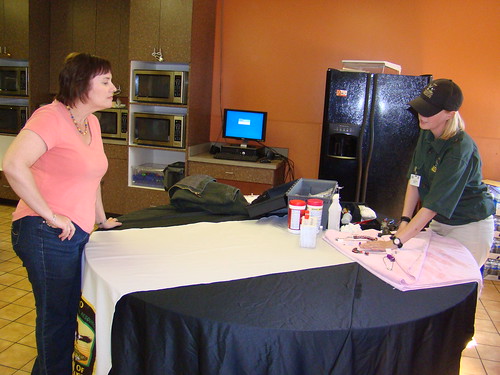
Mary Ann and Jenny
(Jennifer Norris with our Mary Ann)

From the ODNR website:
"Along with several other Midwestern states, Ohio began introducing the birds in 1989. Several pairs were released in cities between 1989 and 1992. Last year in Ohio, 19 nesting pairs of peregrine falcons are estimated to have successfully hatched and fledged 64 young. An estimate was made because actual counts were unavailable due to site access for some nests.
Federal funds for the peregrine falcon project and other wildlife diversity efforts of the Division of Wildlife are provided through the State Wildlife Grant Program, which targets species with greatest conservation need.
The division's peregrine falcon management program is funded by the sale of cardinal license plates, the division’s new Ohio Wildlife Legacy Stamp and contributions to the state Wildlife Diversity & Endangered Species Check-off Fund. "


Quick note about bands:
close up bands
These dual-colored bands will show up at a distance and the letter/number combination can easily be read. They are read from top to bottom, so the one on the left would read "black over red, 16Y".
If you ever see a banded peregrine falcon, here's a handy chart to tell you where it came from:
Red                 Captive bred
Black/red bicolor Eastern United States
Black/green bicolor Eastern United States
Blue Tundra Peregrines
Black/blue bicolor Tundra or Anatum captured off the breeding grounds or subspecies unknown
Green Peale's Peregrines
Black Anatum Peregrines
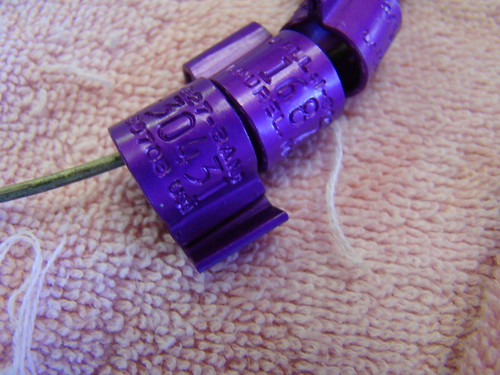


USFW bands
Another band, in purple, is fitted on the other leg. These are USFW bands.


We found out that a local sixth grade class (I did a program at that school!) came up with names for these chicks. Since Mary Ann, myself and one other woman were the only audience members, we each got to choose which falcon would get which name.

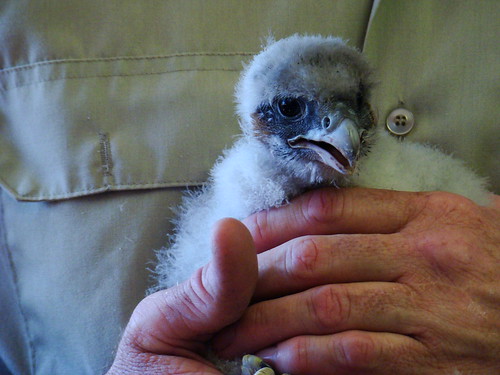
And here are the babies (all females, by the way):
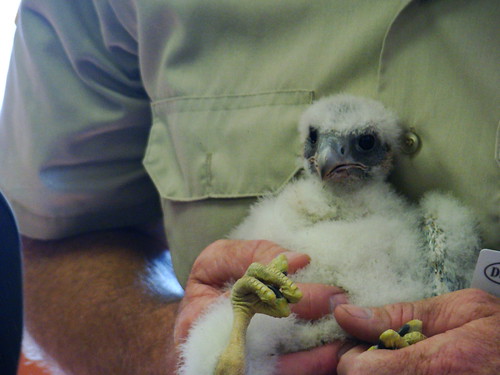
Skylar
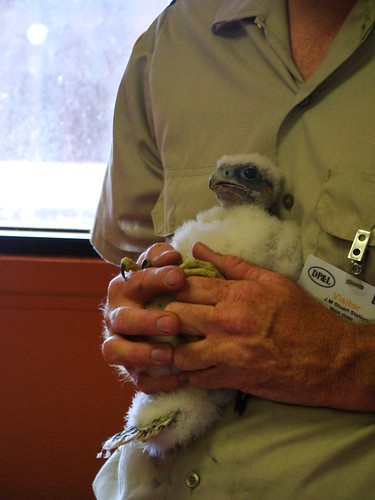
Skylar


Flyte
Flyte


Epic
Epic

(The largest and likely the oldest of the three. This is the one I named!)


Aside from the bands, parasites and blood samples were collected:
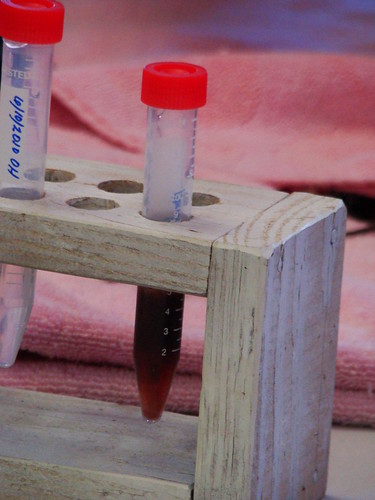
blood sample


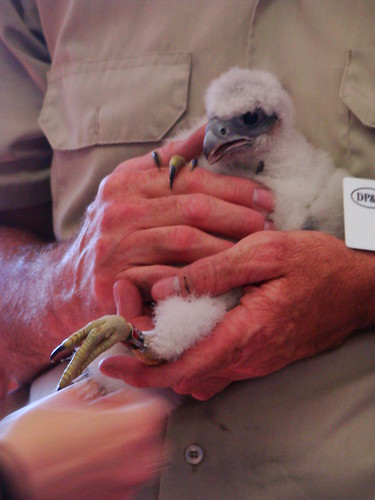
Peregrine chicks start out life not with that majestically long, rudder-like tail, but instead sport a stubby butt that looks like it belongs on a chicken:
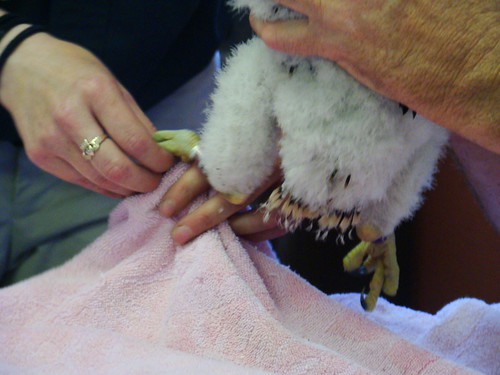
peregrine chicken butt


limp toes
Check out the limp toes (this is a defense mechanism).
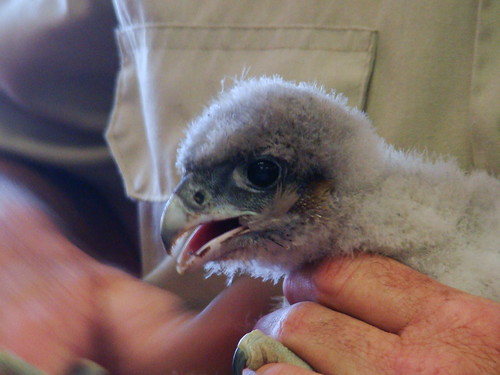

food feather
Epic had the remains of breakfast stuck in her beak (see the tan feather?).
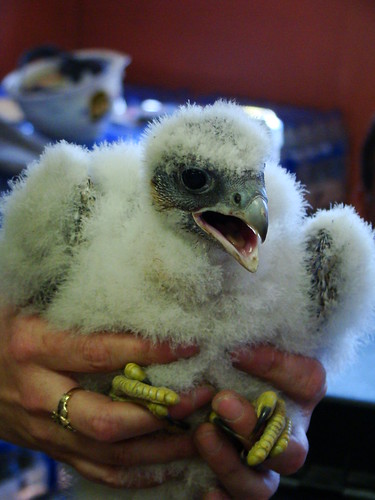

PEFA 12 Y
Let's just soak in the adorableness of that face for a minute......


These babies will grow up to be the race cars of the sky, blue-gray thunderbolts that split the air with their speed and strength. But this day, at 3 weeks old, just fuzzy white perfection.

This last photo makes my heart do a drum roll.
Those toes, the same type of toes that curl around my thumb and forefinger on a regular basis, that clench my hand when the owner needs reassurance, the toes that take food from my hand and have a firm hold on my heart....
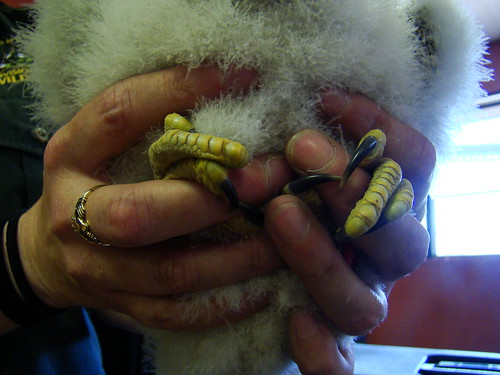
Fingers and toes

Good luck, little ones. Go forth and multiply.

Monday, May 26, 2008

What a weekend!

I have lots of photos, so if you are still one of those poor dopes with dial-up, go get a massage or a few beers and wait.


Da da dum dum, da da dum..............
Ready?

THURSDAY:
Isabelle graduated from Kindergarten. I cried. A lot.
Isabelle K graduation


(photo by Swami)

FRIDAY:
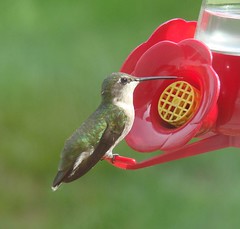
Caught some teeny hummingbird tongue action.


Female hummingbird tongue


Powder thought my nice Longaberger bread basket would do for a bed.
Powder in a basket
Makes her look like she forgot her body somewhere.


SATURDAY:
I took the bird-sicles that Kathi gave me, to RAPTOR. I thawed out a starling and gave it to Lucy.

Lucy holding Kathi's starling
I left her alone, and by the time I came back to put her back she had de-headed it.

I did some glove training with No-No:
No No in the sun
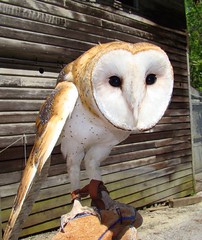
I could look at him all day. What a mixture of textures...pure white, copper, chevrons of dark grays...and let's not forget those big liquid eyes....Ooooooo.

Our first yard bird babies of 2008 showed up to learn how to use the feeders.
House finches:
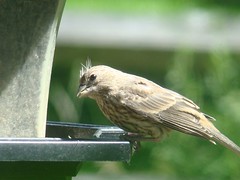
Close up HOF youngin
Why is it that the last of the baby feathers are ALWAYS on top of their heads, like bad haircuts?
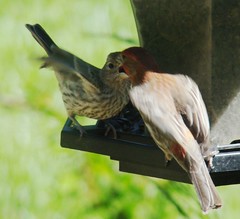
Feed me...I'm yours
"Dad? Dad? Dad? Daaaaaaaaad? Daaaaaaaaaaad?"

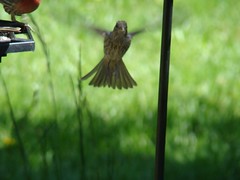
HOF fledgling
This one hovered awkwardly for about 10 seconds trying to get back up to the feeders.

SUNDAY:
Picnic at Germantown Metropark.
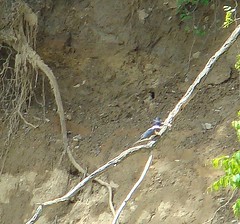
My first kingfisher nest, on a cliff above the dam backwater:
Kingfisher bringing fish back to nest
Carrying a fish back to the babies!

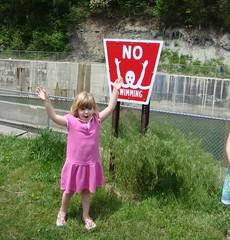
This sign is by the fence above the backwater, just for those dummies who would think that a swim in an active backwater would be a great idea. I asked the girls to stand in front of it with frowns on their faces, and Lorelei, without any prompting, struck this pose:
NO SWIMMING!
Yep, that's my kid.


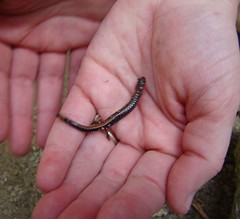
We took a nature walk and found a red-backed salamander:
Red Backed salamander
Look, Nina! A Sally-mander!

I started turning over buckeye leaves and found a little blue caterpillar:
Blue caterpillar on buckeye
What kind of caterpillar uses buckeye for a host plant? Anyone know?

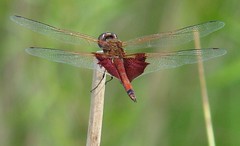
And a life dragonfly:
Carolina saddlebags dragonfly
A Carolina Saddlebags. A goofy name for a spectacular dragonfly.

I didn't even include all the gardening I did in the past few days. I am typing with most of my fingers wrapped in Band-Aids. I will have to save all that excitement for the next post.

Monday, May 12, 2008

Bird stories

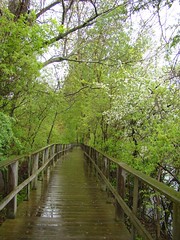
The Beautiful Boardwalk


Here's my list of birds seen and/or heard this weekend (Thanks to Kathi, this list is way longer than it would have been if I had been alone):
Bold = LIFER
(there are only seven lifers...I must have miscounted. But still....)
***
Canada goose
Tundra swan (yes, I saw a live one)
Wood duck (In a TREE, no less)
Mallard
Northern shoveler

Double-crested cormorant
Great blue heron (100's)
Great egret (100's)

Turkey vulture
Bald eagle
Red-shouldered hawk
Red-tailed hawk
GOLDEN EAGLE (!!!!!!!!!!!!!!!!!!!)
American kestrel
Peregrine falcon

American coot

SEMIPALMATED PLOVER
Killdeer
Greater yellowlegs
Lesser yellowlegs
Spotted sandpiper
Ruddy turnstone
Dunlin (500 +)

Ring-billed gull
Herring gull
COMMON TERN

Mourning dove

Northern flicker

Eastern phoebe

Purple martin
Tree swallow
Barn swallow

Black-capped chickadee
HOUSE WREN
Golden-crowned kinglet
Blue-gray gnatcatcher
Veery
SWAINSON'S THRUSH
Wood thrush
American robin
Gray catbird
Brown thrasher
European starling

WARBLERS:
NASHVILLE
Yellow
Chestnut-sided
Magnolia
Cape May
Black-throated blue
Yellow-rumped (Hey, Delia! I saw yellow-rumped warblers!!! Hee hee)
Palm
American redstart
Prothonotary
Ovenbird
Northern waterthrush
Yellow-breasted chat

SUMMER TANAGER

White-throated sparrow
White-crowned sparrow

Northern cardinal
Rose-breasted grosbeak
Indigo bunting

Red-winged blackbird (there were at least two RWBB's every five feet. And that's not an exaggeration)
Common grackle
Baltimore oriole

American goldfinch

House sparrow (very very sparse, thank goodness)

And now, some pictures:

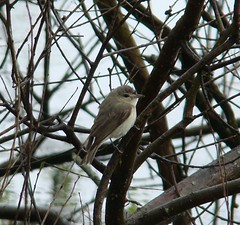
No ID yet
I don't have an ID for this one yet. Anyone want to throw in? It's either some sort of empidonax or a female warbler of some kind.
UPDATE: Kathi can't comment (Blogger's acting like Frogger) but she agrees that this is some sort of empidonax)

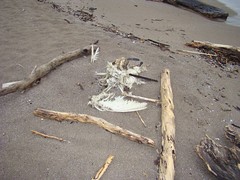
Another dead Tundra swan
Yep, another dead tundra swan. I Chimped, but the body was too torn up to figure anything out. I looked for bands, but this one is anonymous.

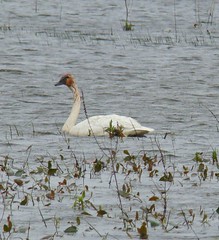
Tundra swan looks bloody
This one was alive, but looked bloody! I watched, and it seemed to preen most of this stuff off. I assume that it just had its head stuck in some mud underwater, and not injured in some way. I observed it for quite a few minutes, and it seemed just fine. Scared me, though.

Crazy Ovenbird
Ovenbirds are just color-crazy. This one was stylin' with that brown-bordered orange head.


Let this be a Gray cheeked thrush!
I would very much like this to be a gray-cheeked thrush. It's not outside the realm of possibility, since Kathi saw one the day before. Anyone?
UPDATE: A Swainson's. Crap.

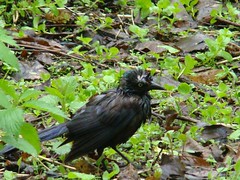
Grackle has a bad day
Poor grackle. He got into a tussle with someone.

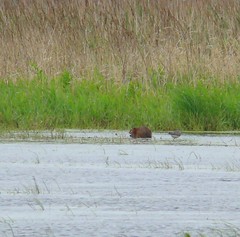
Muskrat and yellowlegs love
A muskrat and a lesser yellowlegs....an odd couple.
Feel free to sing "Muskrat Love" by Captain and Tennille. I'll wait.

Story:
It was getting late in the day, and I knew that I had to start for home soon.
I walked the lake trail that Kathi had pointed out to me earlier, and I am glad I did.

First, I saw the terns that we had glimpsed the day before, but couldn't ID.
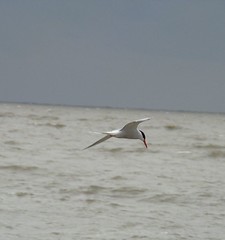
Common terns, soaring and plunging into the very cold water for fish. They didn't even care that I was standing just beyond the water, snapping photos and giggling like a maniac.

Common Tern
They reminded me of the black skimmers the Flock saw at Cape May.
Gorgeous, elegant, graceful birds.

I was preparing myself mentally for the actual removal of body and soul from MY Lake Erie ( I never want to come home after being there), when I noticed that the terns had disappeared before my eyes.
A medium-sized bird was flying parallel to the beach with strong, purposeful wing beats. Hmm. That looks like some kind of dark gull. No, wait. That looks falcon-ish.

A peregrine falcon. Just for me.

Peregrine flying away
(This is the best I could do. My eyes were all teary and I was jumping up and down and struggling with my new birding bra and trying to get the camera up to my face)

Peregrines hold a sacred place in my heart. Lucy was the first one I ever laid eyes on, and her mixture of sweetness and nervousness, and yet that unabashed fierceness, has endeared the species to my soul forever.
So I stood there on a lonely beach on Lake Erie, buffeted by cold wind and freshwater spray, and cried because a peregrine falcon had just passed by. Yeah, I'm all crunchy on the outside, but there's a chewy, gooey center in there somewhere.

Tomorrow: The eagle that didn't get away!

Monday, September 24, 2007

Let's talk about peregrine falcons


Since my camera is going to be in the camera hospital for 2 or 3 weeks, I am going to have to pull posts
out of my a**, I guess.
I like doing species profiles, so let's start off with my favorite raptor, the Peregrine Falcon:


The peregrine falcon's scientific name is Falco Peregrinus, which means Falcon Wanderer.
There are three recognized subspecies in North America: F.P. Pealei from the coastal islands off Alaska; F.P. Tundrius, which nests above the tree line in the Arctic; and F.P. Anatum, which once ranged over North America from coast to coast. They are the same size and weight of a crow.

In the 1960s, scientists discovered that DDT was interfering with egg shell formation of meat and fish eating birds. Healthy birds were laying eggs so thin they were crushed by the weight of the incubating adult. By 1965, no Peregrine falcons were fledged in the eastern or Central United States. By 1968, the Peregrine population was completely eradicated east of the Mississippi River. In 1972, use of DDT was severely restricted in the United States and worldwide.
Efforts to breed the Peregrine in captivity and reestablish populations depleted during the DDT years were greatly assisted by methods of handling captive falcons developed by falconers. (So if you know a falconer, be sure to give them a hug)
***
Neat facts...
The Peregrine's awesome speed and power also made it the favorite bird for falconers in the Middle Ages. The female, which is slightly larger and more powerful than the male, was preferred and only she is given the title of “falcon”.
A male Peregrine is referred to as a “tiercel” or "tercel" meaning third.


Baby falcons are called eyasses (pronounced eye-esses). They are covered by white down when they are born, which is replaced by feathers in three to five weeks. Although they have a high mortality rate, Peregrines have been known to live as long as 15 years. They usually begin breeding when they are about two years old.
They double their weight in only six days and at three weeks will be ten times their birth size.

They are nature's fastest fliers: Peregrines have been clocked in horizontal flight at 40 to 55 mph, and diving, or stooping, at speeds of up to 220 miles per hour. They are the fastest moving creature on the planet.

Peregrine falcons feed primarily on birds they take in the air: their prey includes ducks, pheasants, and pigeons (and if we are lucky, starlings and house sparrows). They hit their prey with half-closed feet, basically punching the bird in mid-air, and either retrieve the dead bird in flight or from the ground.


Falconry clubs are alive and well in the U.S. Falconry is an ancient sport, dating back to China before 2000 B.C. Shakespeare was a falconry fan, who brought falconry terms into popular speech, like "hag" or "haggard" which is a term for a mature hawk or falcon.
Ancient Egyptian art depicts falconry, and Horus, an Egyptian god, was a falcon. The "Eye of Horus" is a stylized falcon eye.

The Peregrine Falcon has one of the longest migrations of any North American bird. Tundra-nesting falcons winter in South America, and may move 15,500 miles in a year.

Peregrines are currently listed as endangered in Ohio. All the major cities in the state have a nesting pair.
Young falcons raised from the nest in Columbus have nested in New York, Michigan and Indiana. Other Columbus young have been observed in Alabama, Texas, West Virginia and Canada. The falcon management program is funded by contributions to the Endangered Species and Wildlife Diversity Fund (State Income Tax check-off and Wildlife Conservation License plate).
Stats from the 2006 nesting season: 18 nesting pairs, 60 chicks fledged.

Now, is it any wonder that Lucy (above) is my favorite?