Showing posts with label osprey. Show all posts

Saturday, September 26, 2009

My moment with an osprey

Sorry for the lack of posts lately. I've been under the weather...but I am bucking up to post something tonight.

The other day, I was in my "Warbler Corner" at a nearby park. Migration brings so many neat things at that spot...usually right outside my car window.
The river runs alongside the spot where I sit...usually nothing more than ducks, geese and kingfishers. This day, I saw what initially looked like a humongous goose coming in for a landing.

But instead of splashing down, it hit the water and then lifted up again. I strained to see through the trees, and when I saw what it was, I started talking to myself:
"Oh, holy ****. An OSPREY."

Only the second one I have seen this year, and even better, it had a huge fish in its talons.
I jumped from the car (left it running!) and slunk along the treeline to get a better look.

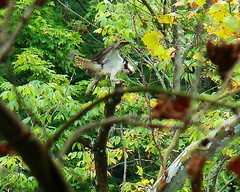
Osprey 1

It was directly across the river from me, but trees were in the way. I stayed where I was, thinking I would never be able to get closer.
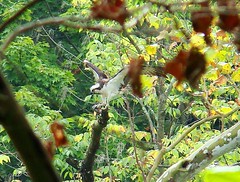
It spent a long time adjusting the fish as it perched....
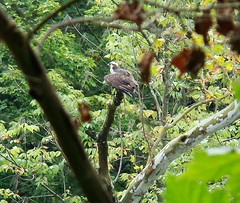
Mantling fish


...just not right.....


Adjusting fish

....adjusting some more....
Adjusting again
...almost there....

Eating
Finally. Time to eat.

I let it eat more than half the fish before attempting to walk down to the river and get free of the trees.

I wasn't much of a threat, it turns out.
I walked around to the canoe access and slowly and quietly down the bank until I was directly across from the bird again. It pretty much ignored me....
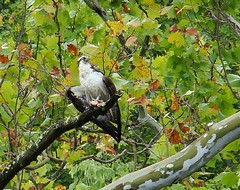
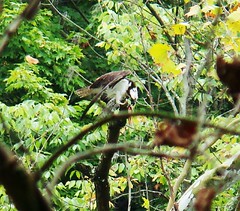
Watching

...mantling its catch and watching for any other birds who might try to steal it.
Resting and watching
For twenty minutes (and the car was still running), I watched this glorious creature.

Every osprey I have ever seen has been a fly-over. Never have I had the opportunity to watch one eat, or perch, even for a minute. And for 20 minutes, this one was mine.
I stood there, grinning like a fool, silently giddy for my luck.

But all good things must come to an end.
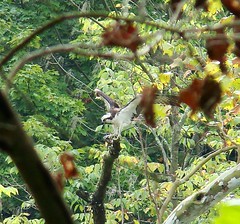
We made eye contact.

Osprey eye contact
And I quietly gave up the field and left it in peace.

Monday, December 29, 2008

Species Profile: Osprey

I haven't been birding in, well, forever.
That means, it's time for a species profile!


Osprey
(Pandion haliaetus)

As its common name (fish eagle) suggests, the Osprey's diet consists almost exclusively of fish. It has evolved specialized physical characteristics and exhibits unique behaviors to assist in hunting and catching prey. Because of its unique characteristics, it has been given its own taxonomic genus, Pandion and family, Pandionidae. Four subspecies are usually recognized.


Description:
  • Large raptor.
  • White breast and belly.
  • Black back and wings.
  • Long wings, held with wingtips angled slightly backwards.(Flying "M")
  • Dark eyestripe.
  • Crown and forehead white.
  • Size: 21-26 inches
  • Wingspan: 59-71 inches
  • Weight: 2.2 to 4 pounds
(Female is larger than male)


Voice:
Short, chirping whistles (kip kip kip kip...up to 20 calls in six seconds)

Habitat:
Breeds in variety of habitats with shallow water and large fish, including boreal forest ponds, desert salt-flat lagoons, temperate lakes, and tropical coasts. Winters along large bodies of water containing fish.
Osprey migrate for the winter. European osprey go to Africa, American and Canadian osprey go to South America (though some may only go as far as Florida and California), and Australasian osprey do not migrate at all.

Hunting:
Osprey dive into water feet-first to catch fish. Will often hover before taking the plunge.
(Osprey have no downy feathers, to help them dry off faster after fishing...another reason they migrate for the winter. Can't keep warm if you don't have downy feathers)
They have sharp spicules on the undersides of their feet, to better grab and hold onto slippery fish. Osprey have "closable" nostrils to keep water out of their lungs, and a special polarized lens in their eyes to aid them in looking into deep water.

When a fish is caught and the bird is flying to perch and eat, they will turn the fish so that it is facing forward, to make them more aerodynamic and reducing drag...smart birds)

Reproduction:
Osprey build a large stick nest, either on a man-made platform specifically built for that purpose, or will use telephone poles, highway signs, channel markers, etc. Nesting materials have included brush wood, sea wood, corn stalks, shingles, small floats, toy boat, eggs of sharks, old brooms, old shoes, fishing line, cans, doormats, sheep bones (especially skulls), sod with the grass still growing.

It usually takes an osprey three years to reach breeding maturity.
One to four eggs are laid and incubation lasts for about 5 weeks. Young will fledge in eight to ten weeks.


Interesting facts:


The osprey suffered greatly from the wide-spread use of DDT from the 50's through the 70's.
Through the banning of DDT, their numbers have risen, though they are still listed as endangered or threatened in some states, especially in inland states where populations were extirpated during the pesticide years.
Also detrimental to their population was the stealing of eggs by collectors and poaching.

Nisos, a king in Greek mythology, became an osprey to attack his daughter after she fell in love with Minos, the king of Crete.

Pliny the Elder wrote that adult osprey forced their young to fly into the sun, and killed the ones that failed.

There was a medieval belief that fish were so mesmerized by osprey that they would turn belly-up in surrender.

Yeats
used a gray wandering osprey as a representation of sorrow in The Wandering of Oision and Other Poems.

And finally....
Susan would very much like to have an education osprey for programs.