Showing posts with label hawk ID. Show all posts

Sunday, October 05, 2008

Sticking to what I know

The yearly migration to Cape May draws nigh. Since shorebirds and sparrows are not my strong suit, we will focus on hawk IDs.

*observe my blatant ignoring of last post*

When you see a bird of prey, what is usually the situation?
1. Perching
2. Flying away


We will go through some of the more common birds, with all the views.

Red-shouldered hawk:
Perching, front>>>
RS 112807
Look for all that orange. (Immature: dark brown vertical streaking)

Perching, back>>>
red shouldered in the yard
Black and white banded tail, scalloped back.

Flying away>>>
(unashamedly stolen from Kyle's blog)


Their wings kind of remind me of checkerboards.


Red-tailed hawk:
Perching, back>>>>>
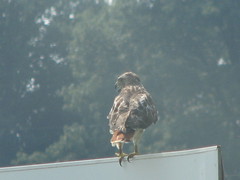
Talons and tail
Red tail....red tail....red tail....
(Immature: Brown striped tail)

Perching, front>>>
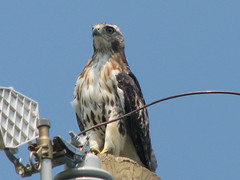
RT front view
Dark belly band on a pale front.
*Word about red-tailed hawk plumage...this is the most variable hawk in North America. They can be very pale, all the way through the spectrum to very dark. There are four light morphs and three dark morphs. Lighter birds have a pale "V" on their backs that can be seen while perched.

Flying away>>>
(stolen from Kyle, again)


When you see a large hawk flying overhead, and can't see the color of the tail, look at the underside for dark crescents at the wrists...red-tailed.

Cooper's Hawk:
Perching, back>>>
coopers hawk
Dark cap, dark gray back, long long tail.
Word about Cooper's vs. Sharp-shinned: Size is a good indicator, but tough in the field (and a female Sharpie and a male Coop are about the same size).
Sharpies have a dark "hood"....Coops have a "cap".
Coop's tails are rounded, Sharpie's are squared.

Perching, front>>>
Coop
Pale chest with orange barring. Long long tail.

Flying over>>>
hawk silouette 1
I love this shot (got it as I surprised a Coop as I came around the corner of the house).
A typical accipiter silhouette. Short wings, long tail.


Other birds of prey, in flight>>>

Broad-winged hawk:


Look for that wide white band on a otherwise dark tail. And a crisp dark outline of the wings.

Rough-legged hawk:
Rough legged hawk 1
The black "windows" on the wrist are distinctive.
They will "kite" and hover while hunting. Great photo ops.

osprey

Osprey fly with crooked wings. They keep their wings bent at the elbow (drooping "hands").
And they are huge. Hard to mis-ID an osprey.
The dark areas under their wings remind me of a Tiny Tim crutch.


Well. I feel better. Gotta look at the bright side. Because it's...well...brighter.

Friday, September 14, 2007

Hawk silhouettes, a surprise flower and a picture by Isabelle.

I got a good silhouette picture of a hawk today, so I thought I would do another "Hawk ID" post.


So, beginning birders, what type of bird is this?
If you want to go back and read my previous post about hawk ID's, clickity-click here.
hawk silouette 1

Long tail. Short wings. Head extends far beyond shoulders, looking like a mallet.
Cooper's hawk.
Also, when you are watching a hawk fly away, (which is usually how you are seeing them) accipiters have a flight pattern of flap-flap-glide.


Hawk sil 2

Short tail. Long wings. And of course, a red glow to the tail.
Red-tailed hawk.
The flight pattern of red-tails is soar-soar-glide.
Difference between RT and red-shouldered hawks in flight: Look for the white crescents on their wings.
Remember the rules of anatomy: Form equals function.
Cooper's hawks are forest hunters, so they need speed and agility to chase their prey (usually birds) through the obstacle course of trees. Hence the rounded wings and long tail (acts like a rudder)
Red-tails are more of a open area hunter, and are built to soar. Hence the long broad wings.


TV silouette

From a distance, this could be lots of things. But even at a distance, if it is tilting back and forth as it soars, you are looking at a vulture. And the lighter underwings are a good tip-off that you aren't looking at a bald eagle.
Differences between black/turkey vultures:
BV's are smaller than TV's, and have black heads versus the red head on the TV's. But if they are way up in the air, that isn't helpful.
But BV's have whitish primaries (the "fingers" on the wings)


And to add a bit of frivolity to this post, here's a quiz:
I found a flower in a surprising place today. Anyone want to guess what this is?

IMG_7471
Scroll way down for the answer.


IMG_7473

Yep, it's butter.
Why did I take a picture of butter?
It could be either:
A. It was just so cool, I had to. It's a floop of butter!
B. I was under the powerful influence of a spread with no trans-fat.
C. I am Blogzilla.

Finally, a picture of Elvis drawn by Isabelle:

Isabelle's pic of Elvis
Elvis in the middle (see the barring? What a smart girl.)
On the right, a dead rat on the feeding block.
On the left is me, looking in through the door slats.


Sunday, August 12, 2007

Hawk ID answer, miscellany Sunday


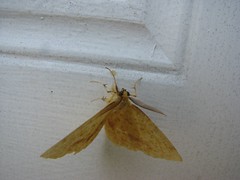
Yesterday we discovered this moth on the front door, and I think it had just laid an egg...there was a small yellow thing near it's backside.

IMG_6078
I can't tell if it is a False Crocus Geometer or a Chickweed Geometer.
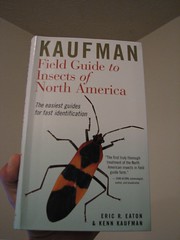
The only reason I sound like I know what I'm talking about is because I looked it up in my new:

A gift for myself

I hear that this is THE field guide for insects, and that Kenn even inserts some humor.
And really, how cool is Kenn Kaufman? The man has his own Wikipedia entry. I wanna meet him. Hey, Kenn? Come see us in Cape May!

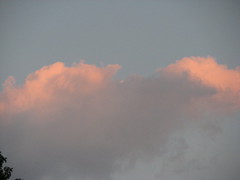
Wish they were rain clouds

Sigh...even though we really need these to be rain clouds, they aren't. But pretty anyway.

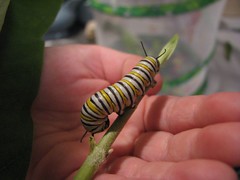
Snookie grows


Snookie is growing and eating and pooping.
(For a funny take on monarch ranching, see Jess' post here. That woman makes me shoot milk out of my nose on a regular basis.)


We have yet another wee animal in the house.
Isabelle discovered them first as they left this morning, then after I hauled my cookies out of bed later, I saw them too:

Tiger Lily the tadpole

Tadpoles in the fountain. Since I never found any tree frog eggs anywhere (which is crazy, since it sounded like they were knockin' boots EVERY night) I guess these are bullfrog tads.
Isabelle almost turned herself inside out as one was brought into the house and placed in her previously disastrous Frog Habitat: disastrous because the tadpoles stayed tadpoles for 8 months and when I thought they might need some sunlight, it got so hot that it killed them.
We only brought in one, just in case we goof it up again.
Isabelle named the tadpole Tiger Lily.
*****
Now, onto yesterday's hawk ID quiz:
Donald the Birder (who I just realized is in Cincinnati) got it right...a juvenile red-shouldered hawk. Donald, if you want a freshly minted Cape May Birder Blogger Conference T-shirt, email me your address and what size at capricorn1273@cinci.rr.com.
Juvenile hawks are very tricky, and even if you know what you are talking about, you may have to pour over a field guide first before being sure. Lynne was pretty close with a guess of Broad-winged. And yes, Lynne. You still get to come to Cape May. And you get a T-shirt because you are Flock member. In fact, everyone in the Flock needs to send me their T-shirt sizes so I can distribute the shirts.
And don't forget that you and I came up with the idea of going to Cape May in the first place. Remember when I was planning on coming up to Minnesota in February and Laura wouldn't come, so we said, "If Mohamed can't come to the mountain..."?

Education Corner time:
Red-shouldered hawks are divided into 5 subspecies. Our subspecies in the north and east are the largest.
Juveniles in the east streaked brown and white on underside, brown above, tail with dark and light brown bands, and their wing crescents are tawny. They are very similar to juvenile broad-winged hawks, but can be distinguished by their longer tail, wing crescents and accipiter-like flight patterns.
Interesting tidbit: Four of the subspecies exist on the eastern side of the continent and contact with each other, but the West coast form is separated from the other four by about 1000 miles! and the Florida form is the palest, with gray heads and very faint barring on the chest.
Want to get really confused? Check out the possibly-only documentation of a red-shouldered X red-tailed hawk hybrid. I take this seriously because David Sibley weighed in on the issue.

I need to do more raptor ID posts. They're fun, aren't they?

Saturday, August 11, 2007

Suey, whaddya see? The greatest duck in history!

What would a weekend be without frenzied activity? Damn lonely, that's for sure.
Geoff had another book signing today, this time at a marathon (when I told my Mom this, she said, "What? At a gas station?") and I took the girls to RAPTOR with me and when Geoff was done, he came and got the girls. We do a lot of car/kid swapping and it wears me out.
As the girls and I were about to leave the neighborhood, we saw this:
Ducks on parade
Ducks on Parade!
When I saw them, I thought of the song near the end of Charlotte's Web...

My land, isn't he grand?
Zuckerman's famous pig
Golly, you gotta agree he's a real celebrity
Fine, swine wish he was mine
What if he's not so big?
He's some terrific, radiant, humble thig-a-majig of a pig
The terrific, radiant, humble
Zuckerman
Zuckerman
Zuckerman
Zuckerman
Zuckerman's
Zuckerman's famous pig!
Sorry, went on a little long there...
But don't they look like they are in a parade? And the one in front looked like he was sporting a tuxedo.
When I got out of my car, they ran at me.
Like I was a loaf of bread and just flashed them the goods.

Isabelle and duck parade
These ducks have been seen around the subdivision for awhile now. And no one knows who they belong to. They are way too friendly for their own good. One bit me, and one bit Isabelle. I shooed them off the street and we went on. Geoff, can we have some ducks? We can let them noodle around in the back yard, and it will give Nellie and Hooper something to do. They can practice their herding.
Eyeball beetle
Research is ongoing as to what kind of bug this is. It moved like a Garthim.

I had gone out to pick some fresh milkweed, and found a monarch cat I obviously had missed for the past week or so:

Introducing Snookie
He is a biggin. Probably in his 5th and last instar. So I should be able to post his transformation into a jade earring soon.

And now, a bird quiz:
We have a possible new program bird at RAPTOR. She has been jessed and Jeff (Of tree-climbing fame) worked with her some today. We are giving her one more chance to make a full recovery from a broken wing, but if she stays with us, she will go out on programs with me.
I don't think Mon@rch should be allowed to guess on this one, since he has so much experience with banding and so on. But if no one gets it right, I will let him guess.

She's in a mew with Scarlet, our red-tailed hawk.
Any guesses on what kind of bird she is?
Hint: She is a juvenile. But that's not really a hint. Juvenile birds of prey all look alike.
Come on guys...make me proud.
The prize: I will make you a "Cape May First Annual Birder Blogger Conference" T-shirt.

Tuesday, June 05, 2007

Cooper's versus sharp-shinned


I have had requests to do an identification thing about Cooper's hawks vs. Sharp-shinned hawks.
I didn't have any pics of Sharpies, so I had to borrow.

Coops and Sharpies can be tricky to differentiate.
They are both accipiters, both are woodland birds and their markings are almost identical.
But a few things can tip you off:
1. Size: Coop's are crow-sized (15 inches long for males, 18 inches for females)
and Sharpies are jay-sized (9-11 inches for males, 12-14 for females)
BUT: There are exceptions...you might see a very small Coop, and mistake it for a Sharpie. so size is not always an indicator.

2. Head: Coop's have a dark gray "cap" that does not extend down the back of the head. Feathers also are raised in a bit of a crest in the back, which you will never see on a Sharpie.
Sharpies have a dark gray "hood" that DOES extend down the back of the head.
Remember: Coop's=CAP
Sharpies=HOOD


3. Body: Coop's have a "tubular" appearance, with a broad chest and thick body.
Stocky (think "TUBE").
Sharpie's have a broad chest and thinner hips, lending to a upside-down triangle.
Center of gravity looks HIGH (think APPLE).

4. Tail: The best indicator...
Coop's have a rounded tail with a broad white tip. The middle feathers are usually the longest.
Sharpie's have a squared tail, with a very thin white or gray tip.

5. Legs: Coop's legs are a bit thicker, Sharpies have pencil-thin legs. Both are yellow.

6. Flight: Coop's have a slower wing beat followed by a glide.
Sharpies are more erratic, with quicker beats followed by a glide.
In flight, a Coop's head will extend far beyond the shoulders, looking like a cross.
Sharpies have a much shorter neck, looking like a mallet.


Photo by Bill Diedrich
Sharp-shinned hawk. Note the "hood", the broad chest and narrow hips, the very thin terminal band on the squared tail and pencil-thin legs.


coopers hawk
Cooper's hawk. Note the "cap", the thick body and wide white terminal band on the tail.


Photo by Chris Erion
Sharp-shinned hawk. Same thing: "Hood", thick body and slim hips (think "apple") and thin terminal band.


Photo by Patrick Lynch
This is a good picture to demonstrate size. This bird is no bigger than a blue jay.


Coop at the yurt
Cooper's hawk. Thick body and "cap".

Any questions?