Showing posts with label monarch. Show all posts

Monday, July 27, 2009

Mama NEVER said there would be days like this!

When I have a day like I did today, I thank my lucky stars that I found Nature.
Some people find Jesus...but they will have to excuse me if I think wild things and the outdoors are a bit more riveting.

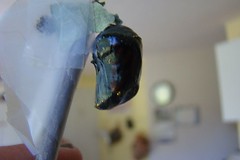
The day began with the discovery that "Monty" our windowsill Monarch chrysalis, had turned to black. (It actually turns transparent, but the blackness of the new butterfly makes the chrysalis look black...just means it's ready)


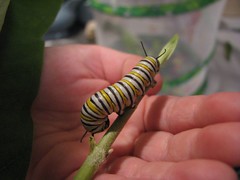
On July 7th, "Monty" was a tiny (10 mm) caterpillar:
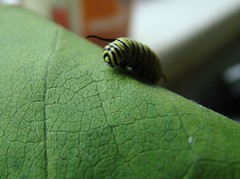
Monarch cat 070909

By July 17th, it was as large as my pinkie finger:
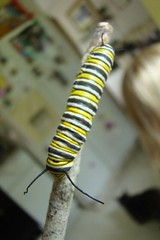
DSC09625

Black chrysalis
*See the small splits near the top? Ready to pop!*


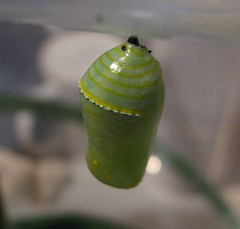
Non-nature peeps: Monarch butterflies lay their eggs on toxic plants like Milkweed. The caterpillars, after hatching, eat the Milkweed leaves, ingesting and storing the toxins in their bodies. This makes them taste VERY bad to birds and other critters who would try to eat them. After two weeks of eating, the caterpillars hang from a nearby stick and go into the "J" position (they really look like a "J"!) and their skin splits open to reveal a perfect jade-gold chrysalis. After about 10-12 days, they emerge as a beautiful Monarch butterfly.

The really WILD part: when the caterpillar is encased in the chrysalis, it becomes a blob of nondescript GOO. No discernible parts at all...the goo then reassembles into a butterfly.
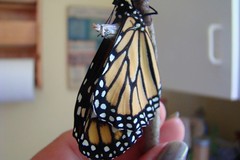
Little bit of chrysalis left
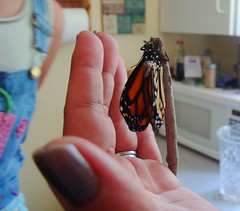
All the way out of the chrysalis...that bit of gray film is a bit of the chrysalis stuck to one of the antennae. I was worried about this when it became a chrysalis...a small tear developed in the chrysalis when it formed.
They are wet and soft at first, and the caterpillar had chosen a bad place to "J", up against one of the milkweed leaves, and the skin retracted and pulled on the fresh chrysalis. The weight of the chrysalis pulled it open a bit, so I very very very gently cut the skin away from the chrysalis and used a Q-tip to push the torn bit back to the chrysalis.
They really have to hang perfectly free from anything to develop properly...and a tear in the chrysalis could possibly not bode well.

And so I fretted for 10 days.
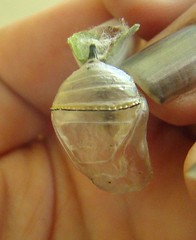

Empty Chrysalis
*Empty chrysalis*


All the way out
*After very very very gently removing bit of left-over chrysalis*
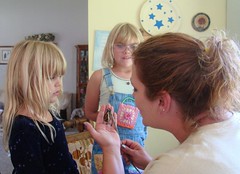

Girls watching monarch
The girls (and I) were just floored by all this. It even brought Geoff down from his office, to take pictures of this little miracle.

I took the new butterfly outside for warmth and sunshine.
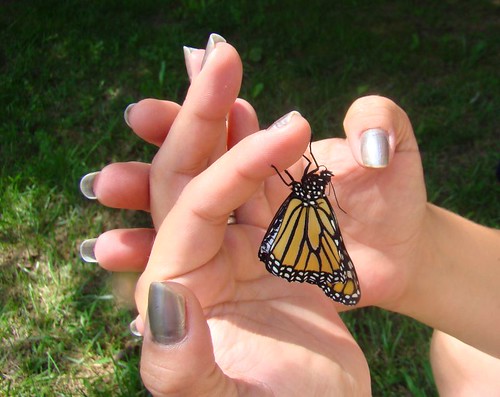
Stretching wings outside
When they emerge, the wings are wet and crumpled. They pump fluid from their bodies into the wings until the wings become stiff. And then it's time to fly.

After the wings dried, I checked to see if "Monty" was a male or female. The way to tell:
Male Monarchs have a black patch of "sex scales" on their hindwings. "Monty" didn't have any sex scales. "Monty" was a girl.
Lorelei got the honor of naming this girl butterfly. So "Monty" became "Veronica".
(Geoff has been reading old Archie comics to Lorelei at bedtime.)

:)
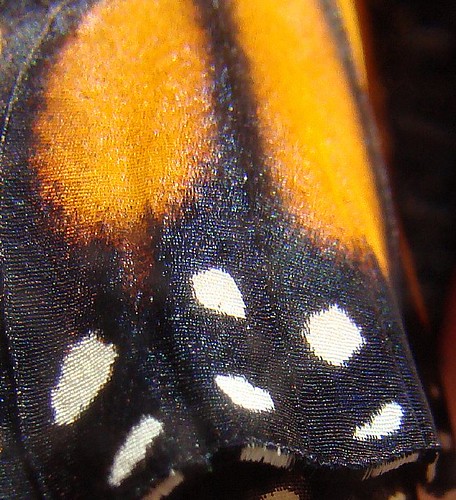

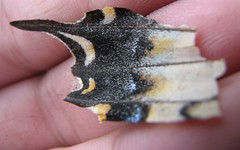
Macro monarch 2
*Macro of one of Veronica's wings. Shimmering, overlapping scales. Reminds me of feathers.*

Veronica was placed in the milkweed patch, where she could get some peace and some nectar.

More cool things about monarchs:
Monarchs born in the early summer have a life span of less than two months. They reproduce and die.
Monarchs born NOW are genetically different from the ones born earlier. They enter a state called diaphase, a non-reproductive state, and can live for seven months.
Veronica, along with millions of her kind, will migrate to places like Mariposa Monarcha Biosphere Reserve in the Mexican states of Michoacan and Mexico.
The generation that overwinters won't reproduce until it leaves the overwintering site in February or March. Their children will complete part of the journey, and the third and fourth generations past Veronica's will return to the home locations in the US and Canada.
So no single butterfly makes the entire round trip.
And we aren't sure as to how the species returns to the same overwintering sites every year. Still being researched is the theory that they use circadian rhthym or that the flight patterns are inherited.
Even cooler: People are tagging monarchs (like bird banding, but tinier).
And today, our household was a minuscule part of a vast journey that spans continents.
Veronica will spend her life in Mexico, enjoying the company of millions and millions of butterflies being born now, east of the Rockies. (Western monarchs overwinter on the California coast.)
This is so unbelievable cool.

After all that, Isabelle and I walked down the driveway to get the mail. Walking back, we saw a red-shouldered hawk on the fence near the prairie. And I had my camera.
*Of course I take my camera with me to get the mail. Doesn't everyone???*
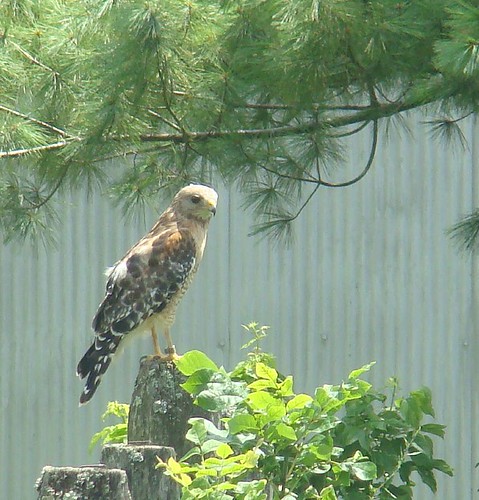
Banded RSHA back yard
Notice anything about this bird?
Banded. Hot damn. A banded RSHA. This is the first banded hawk we have seen in the yard.
Their appearances in our yard are cyclic. Many in the winter, many in the summer. Virtually zero in between.
I couldn't even begin to read the number on the band, but I notified Jeff Hays (from this post and this post). From what I remember, none of the resident adults were ever banded, so this is likely one of the chicks born around here in the past few years. Or it could be a bird from somewhere else. Either way, I was happy to see it.
It was very very very interested in the critters that live in the prairie. See why I built it?
Raptor food!!!!
All in all, a great day.
I better go lie down now. All this delicious nature stuff has me lightheaded.

Tuesday, August 14, 2007

"Houston, we have a pupa..."

(I was so proud of that title when I thought it up, I had to call Geoff and tell him about it)

Snookie is wrapped up in a sweet, surprisingly tiny chrysalis. I was surprised at how small it was...in pictures on other's blogs, etc, they look big, like the size of a bowl of a spoon...but it's less than 2 inches long. And you can't really call them cocoons, because they don't spin silk like moths do. Chrysalis or pupa.

Pupa

I wanted to be there to videotape it turning into a pupa, but we were gone.
But you can bet your bippy I will be there to videotape the emergence!


You know the other birds point and laugh
You know other birds point and laugh.


And a totally different bird:

Juv cardinal
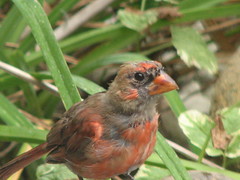
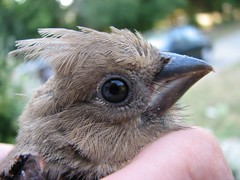
I found this juvenile male cardinal yesterday (with just a beginning of sheathed red feathers), weakly "chipping" near the fountain. I had my camera, so I got one quick pic, examined it to see if it was flighted (it wasn't) and took it in to get a box and to call Marilyn, one of our RAPTOR rehabbers who also treats songbirds.
The poor bird died in my hands in less than two minutes.

One of two owl emotions

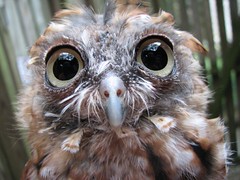
This is one of two emotions that owls have.
One is disgust, and the other one is this...startled.
News: Our gray screech owl has made a full recovery from her foot infection, and should be back at RAPTOR tomorrow! Yippee!
Now the red SO won't be publicly humiliated anymore. He can molt in peace. And by the way, I have seen "Molt" also spelled "Moult". They are both correct, right? English is stupid sometimes.

Okay, birders...someone please, please tell me I can put these on my life list...
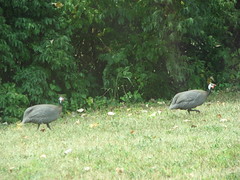
Guinea fowl!

Guinea fowl!
They were out in the middle of nowhere (no house anywhere near them), and ranging free. Someone tell me that this is a well-established introduced species that is now part of our avifauna.
What do you think? Listable?


News:
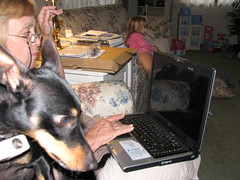
My Mom, the woman who didn't get an answering machine until the late 1990's, now has a freakin' lap top.

My Mom has a freakin lap top!
...With a wireless connection, which I connected for her, I might add.
She's entered the 21st century. I'll be dipped.
(Look at the fingers sticking up...I think she is afraid that it might blow up if she touches it too roughly.


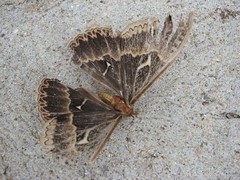
T moth

Can't find the ID for this moth.
You'd think those "T" shapes would be easy to find in a guide.

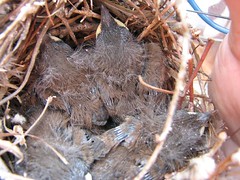
Baby wrens growing

Mom's wrenlets are big and fluffy and strong. At least a few baby bewds came from that nest box.

Tomorrow, I get to meet a fellow blogger. Trixie is in Cincinnati and we are going to meet up and let the kids play (so we can talk, hopefully), and I'm sure it will be bloggalicious.

Sunday, August 12, 2007

Hawk ID answer, miscellany Sunday


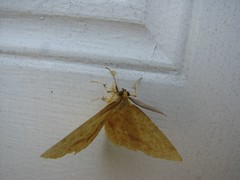
Yesterday we discovered this moth on the front door, and I think it had just laid an egg...there was a small yellow thing near it's backside.

IMG_6078
I can't tell if it is a False Crocus Geometer or a Chickweed Geometer.
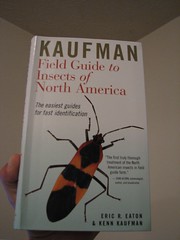
The only reason I sound like I know what I'm talking about is because I looked it up in my new:

A gift for myself

I hear that this is THE field guide for insects, and that Kenn even inserts some humor.
And really, how cool is Kenn Kaufman? The man has his own Wikipedia entry. I wanna meet him. Hey, Kenn? Come see us in Cape May!

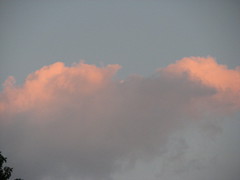
Wish they were rain clouds

Sigh...even though we really need these to be rain clouds, they aren't. But pretty anyway.

Snookie grows


Snookie is growing and eating and pooping.
(For a funny take on monarch ranching, see Jess' post here. That woman makes me shoot milk out of my nose on a regular basis.)


We have yet another wee animal in the house.
Isabelle discovered them first as they left this morning, then after I hauled my cookies out of bed later, I saw them too:

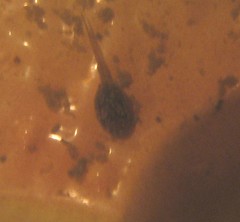
Tiger Lily the tadpole

Tadpoles in the fountain. Since I never found any tree frog eggs anywhere (which is crazy, since it sounded like they were knockin' boots EVERY night) I guess these are bullfrog tads.
Isabelle almost turned herself inside out as one was brought into the house and placed in her previously disastrous Frog Habitat: disastrous because the tadpoles stayed tadpoles for 8 months and when I thought they might need some sunlight, it got so hot that it killed them.
We only brought in one, just in case we goof it up again.
Isabelle named the tadpole Tiger Lily.
*****
Now, onto yesterday's hawk ID quiz:
Donald the Birder (who I just realized is in Cincinnati) got it right...a juvenile red-shouldered hawk. Donald, if you want a freshly minted Cape May Birder Blogger Conference T-shirt, email me your address and what size at capricorn1273@cinci.rr.com.
Juvenile hawks are very tricky, and even if you know what you are talking about, you may have to pour over a field guide first before being sure. Lynne was pretty close with a guess of Broad-winged. And yes, Lynne. You still get to come to Cape May. And you get a T-shirt because you are Flock member. In fact, everyone in the Flock needs to send me their T-shirt sizes so I can distribute the shirts.
And don't forget that you and I came up with the idea of going to Cape May in the first place. Remember when I was planning on coming up to Minnesota in February and Laura wouldn't come, so we said, "If Mohamed can't come to the mountain..."?

Education Corner time:
Red-shouldered hawks are divided into 5 subspecies. Our subspecies in the north and east are the largest.
Juveniles in the east streaked brown and white on underside, brown above, tail with dark and light brown bands, and their wing crescents are tawny. They are very similar to juvenile broad-winged hawks, but can be distinguished by their longer tail, wing crescents and accipiter-like flight patterns.
Interesting tidbit: Four of the subspecies exist on the eastern side of the continent and contact with each other, but the West coast form is separated from the other four by about 1000 miles! and the Florida form is the palest, with gray heads and very faint barring on the chest.
Want to get really confused? Check out the possibly-only documentation of a red-shouldered X red-tailed hawk hybrid. I take this seriously because David Sibley weighed in on the issue.

I need to do more raptor ID posts. They're fun, aren't they?

Wednesday, August 01, 2007

When you're stuck on what to post about, just walk outside


News: Sharon and Lynne are okay. Thank goodness.
*******
I was wondering what to post about tonight, and thought about just skipping it.
But I wanted to walk the yard, so I grabbed my camera:

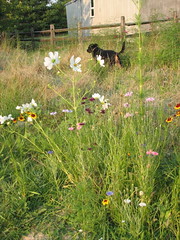
Prairie flowers (and Nellie)
The prairie is giving us lots and lots of flowers to cut and bring in the house. I just wish Nellie would stop walking through the grasses. Her big ass feet are smooshing all of it down!


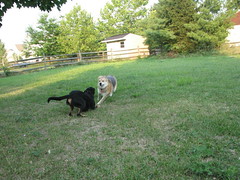
doggie gritties

Shannon had told me about the "Hooper Gritties", but I hadn't seen them until today. When Nellie does it, we call it the "Hyena Run", when she tucks her tail under and runs around like, well, a hyena. (Kind of like bunny binkies, just bigger)
Shannon also told me that Hooper gets the Gritties for about 30 seconds and that's it. And she was right. Nellie and Hooper act like they grew up together. It's wonderful to watch and I am so glad we brought him here. He's a joy to have around.
Fresh sunflower seeds
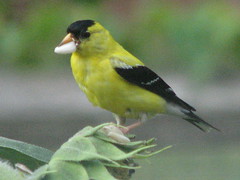
I am also glad that I let a bunch of sunflowers seeds grow into nice, tall plants. The goldfinches and house finches are eating me out of house and home with the thistle, so all the sunflower seeds to be had makes it easier for me to feed them. They have gone through a 5 lb. bag of Nyjer seed in a week.

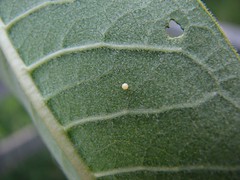
I'm also glad that I checked the milkweed. I have seen monarchs flying through the yard in the
past few days, and I was hoping they would find the milkweed. And they did:
M egg 080107
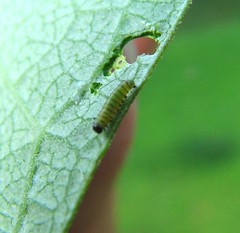
This was thrilling enough, but I looked under some more leaves...
Mcat 080107
...and found tiny, perfect caterpillars.

I rounded up everyone I could find (two cats and three eggs) and put them in the butterfly habitat. Our pipevine swallowtail cats didn't do so good, and that was my fault. The leaves I kept putting in there were drying up too fast, and I didn't think I could put them in water (afraid the cats would fall in, I guess) but I saw on Birdchick's blog that she was putting hers in water, so I did the same.
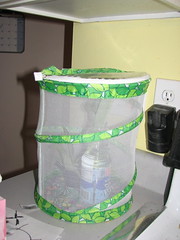
Monarch nursery
Now I am off to research how long all this birthing, pupating and emerging takes!
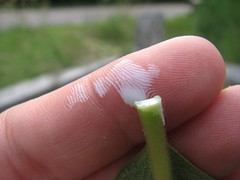
Why it's called MILKweed
And if you ever wondering why it's called MILKweed...
When this stuff dries, it's like plastic, or glue.

See what happens when you plant NATIVE PLANTS ??? No milkweed, no monarch butterflies.
Everyone say it with me...Native, Native, Native, Native, Native.....

Friday, July 13, 2007

A very colorful Friday the Thirteenth


Lots of color today...I would really like to see some cool birds, though.

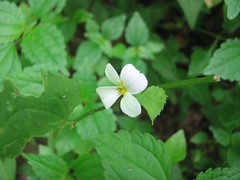
I saw purple:
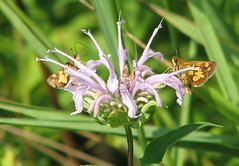
Two skippers
(Skippers on bee balm, Lake Isabella)
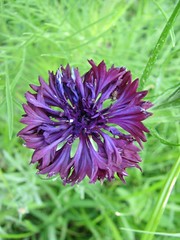
Bachelors button I think
(Bachelor's Button at home)
Inchworm on Chickory
(Inchworm on chickory)


Pink:
Blushing Queen
Did you know that before she is a Queen, Anne blushes?


Orange, brown and green...with a touch of more pink:
Clearwing moth and bee balm
(Clearwing moth on bee balm, Lake Isabella)
Sycamore tussock moth
(Sycamore tussock moth, Lake Isabella)

IMG_5353
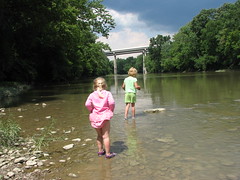
(Look how Lorelei is trying to keep her dress out of the water...like it's anywhere near it!)
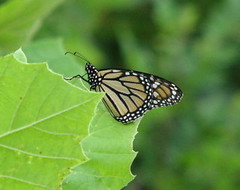
Monarch
(Monarch)


Silver:
Silver


Gold:
Gold


And touches of yellow:

Swallowtail remains
(Remains of a swallowtail)

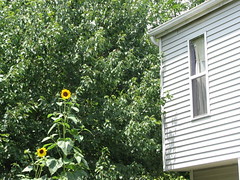
Sunflower success
(Our sunflowers in the back yard...see that window? That's our second story bathroom.
We don't consider the sunflowers a success unless we can see them out of that window)

Saturday, June 02, 2007

Someday, I will get pictures of birds again


I only had a few hours to myself today to do a nature walk.
Since gasoline is like a million dollars a gallon, I chose California Woods.
It's a small nature preserve near the Ohio River, and very quiet and I have never seen more than two people there at once.
Well, duh.
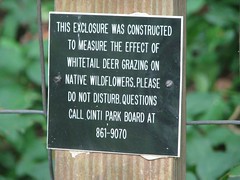
Call me snarky, but do we really need a "study" to find out the effects of deer grazing?
This area was fenced, and full of plants and flowers. The outside of the fence was thinned out.
It seems pretty straightforward to me.

There were very few flowers in bloom...the drought?
(Which ended today, thank goodness...we got a nice soaking rain)
I used the wildflower field guide from the library...If I make a mistake, please tell me:
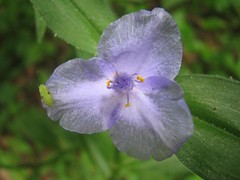
Spider wort and green buggy
Spider wort (and a cute little green bug)
The middle of the flower has a little poof of bluish hair!
(This flower was a lot more purple than the picture looks)
Canada violet
Canada violet

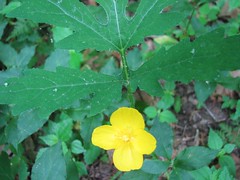
Wood poppy
Wood poppy

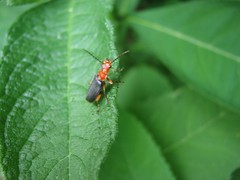
Cute little orange and black bug
This little bug was so cute. He had an "ant" face.
Anyone miss my bird photos? Me, too.
I heard plenty, but since there really isn't an under story at
California Woods, the birds were WAY up.

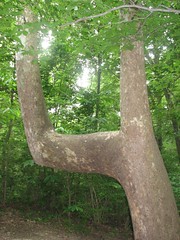
Number 4 tree
A Number Four sycamore!
Demure tree
And a very demure tree, with her legs properly crossed.


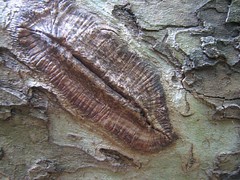
My lips are sealed
The Number Four tree had this scar...looks like a lip print, doesn't it?

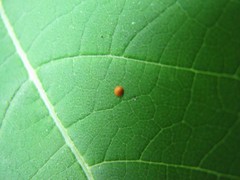
IMG_3821
Anyone know if this is an egg?
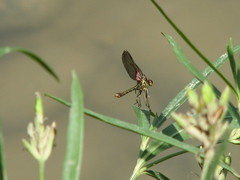
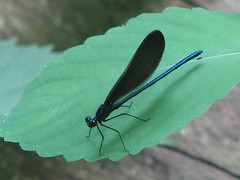
Electric blue damselfly
Electric blue damselfly...I sort of know the difference between dragonflies and damselflies, but damned if I could explain why I think so.

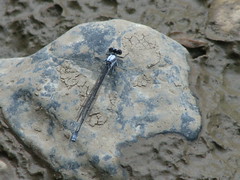
some sort of damselfly
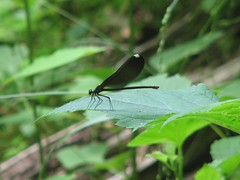
An all-black damselfly with a white wing spot.

And now, on the home front:

Three little robins, sittin in a tree
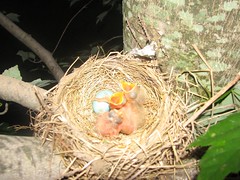
The four robin eggs have turned into three baby robins! (and one unhatched egg)
They can't be more than a day old. How sweet!
***

I am so jazzed about gardening tomorrow. It's supposed to rain, but hey. Rain be damned.
I have milkweed to get into the ground, and here's why:

Wee little MONARCH caterpillar
A teeny, tiny monarch caterpillar!
I wasn't sure of what I was looking at (I have never seen them this young) so I researched and found pictures to match this sweet little guy. I knew their eggs were small, but it seems UNREAL that this tiny wormy-thing will someday be a monarch butterfly.
So little ol' me will be kneeling in the mud, planting and planning tomorrow.